Visual Results
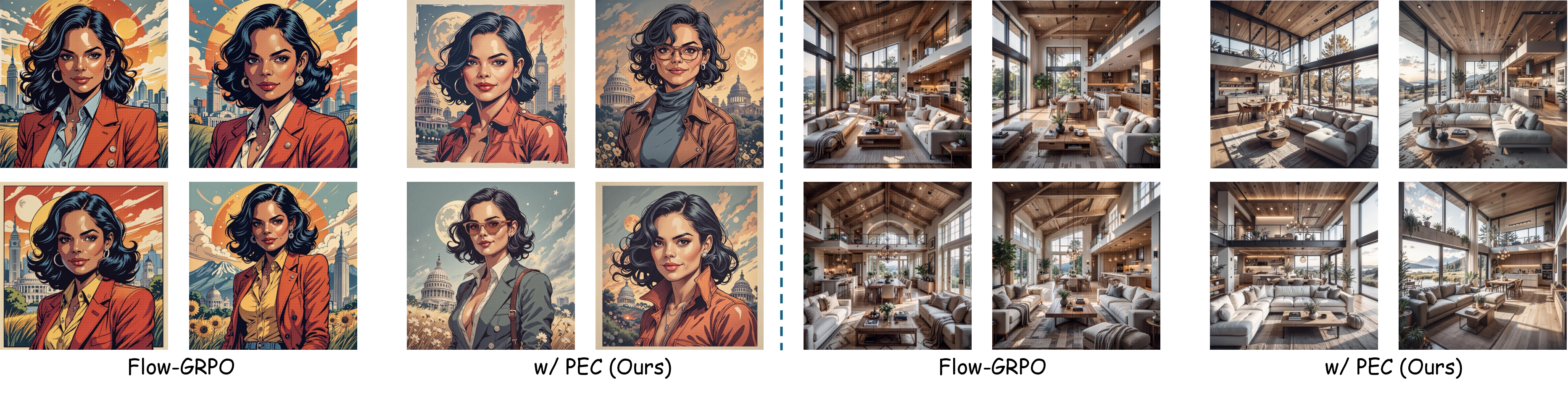
Visual comparison on FLUX.dev. Our methods (PEC & PCVAE) maintain diverse outputs across prompts while significantly improving quality, unlike the baseline which collapses to a single mode.
TL;DR: We reveal a paradox in flow-based RLHF: diversity collapses while policy entropy stays constant. We theoretically explain this through the fixed noise schedule and the mode-seeking nature of policy gradients, then introduce perceptual entropy and two regularized strategies (PEC & PCVAE) that achieve an overall score of 0.734 (vs. 0.366 baseline) while reaching a diversity average of 0.989 (vs. 0.047 baseline) on FLUX.dev and SD3.5-M.
Visual comparison on FLUX.dev. Our methods (PEC & PCVAE) maintain diverse outputs across prompts while significantly improving quality, unlike the baseline which collapses to a single mode.
RLHF is widely used to align flow-matching text-to-image models with human preferences, but often leads to severe diversity collapse after fine-tuning. In RL, diversity is often assumed to correlate with policy entropy, motivating entropy regularization. However, we show this intuition breaks in flow models: policy entropy remains constant, even while perceptual diversity collapses. We explain this mismatch both theoretically and empirically: the constant entropy arises from the fixed, pre-defined noise schedule, while the diversity collapse is driven by the mode-seeking nature of policy gradients. As a result, policy entropy fails to prevent the model from converging to a narrow high-reward region in the perceptual space. To this end, we introduce perceptual entropy that captures diversity in a perceptual space and maintains the property of standard entropy. Building upon this insight, we propose two entropy-regularized strategies, Perceptual Entropy Constraint (PEC) and Perceptual Constraints on Generation Space (PCVAE), to preserve perceptual diversity and improve the quality. Experiments across two base models (FLUX.dev, SD3.5-M), neural and rule-based rewards, and three perceptual spaces (PickScore, DINO, CLIP) demonstrate consistent gains in the quality-diversity trade-off; PEC achieves the best overall score of 0.734 (vs. baseline's 0.366); a complementary setting of PEC further reaches a diversity average of 0.989 (vs. baseline's 0.047).
In LLM RL, an entropy decrease directly signals diversity loss. But in flow models, we observe a striking paradox: policy entropy stays constant while perceptual diversity collapses. This means existing entropy-based regularization methods fundamentally cannot capture or prevent diversity collapse in flow-based RLHF.
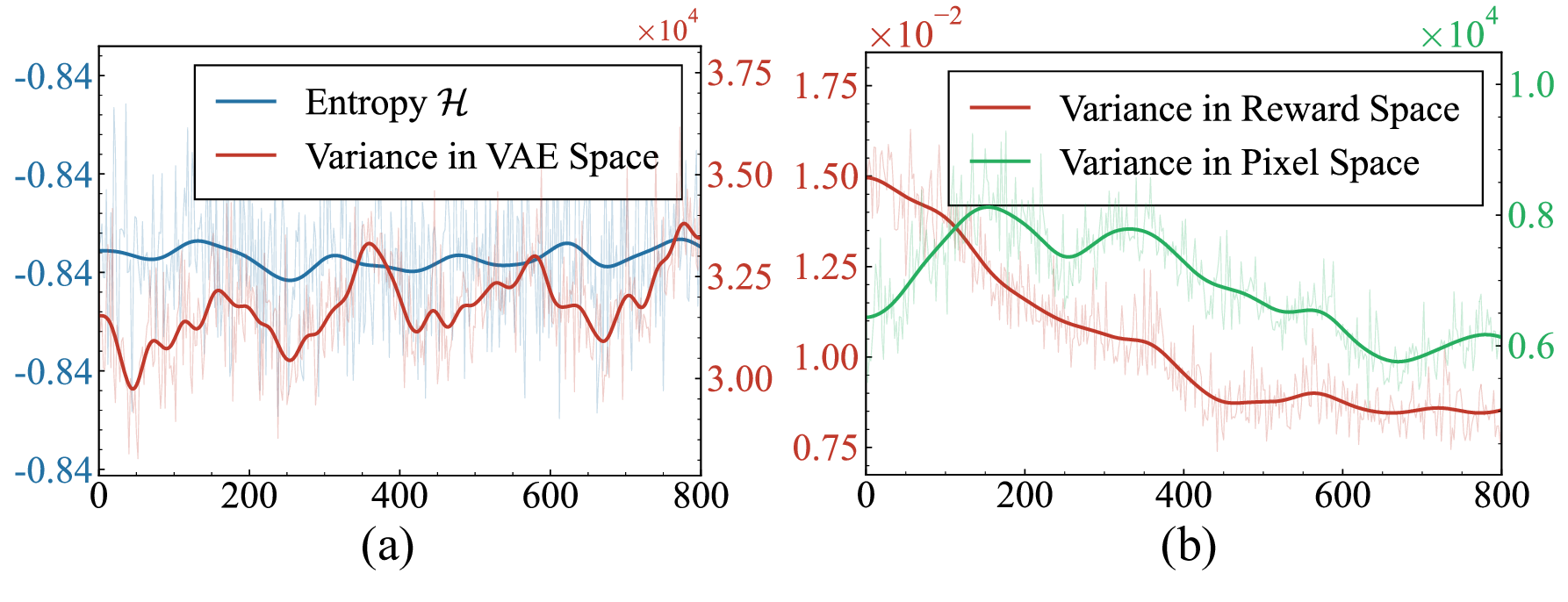
Figure 1. Training-time metrics. (a) Policy entropy and variance in VAE space — both remain constant. (b) Variance in pixel and reward space — diversity really collapses despite constant policy entropy.
We prove that the policy entropy in flow-based RL is independent of model parameters $\theta$. The key insight: in flow models, the reverse transition $p_\theta(\mathbf{x}_{t-1}\mid\mathbf{x}_t) \sim \mathcal{N}(\mathbf{x}_{t-1}; \mu_\theta, \sigma_t^2\,\mathrm{d}t\,\mathbf{I})$ has variance fixed by the prescribed noise schedule $\sigma_t$, while only the mean $\mu_\theta$ is learned. Since entropy depends on the shape (variance), not the location (mean), it remains constant:
We trace the collapse to the mode-seeking nature of online policy gradients: the policy is driven to concentrate probability on high-reward regions in reward space, so a multi-peak pretrained distribution can collapse into a single-peak perceptual distribution. This motivates an RLHF framework that encourages broad coverage of multiple high-reward regions in perceptual space, rather than convergence to a single peak.
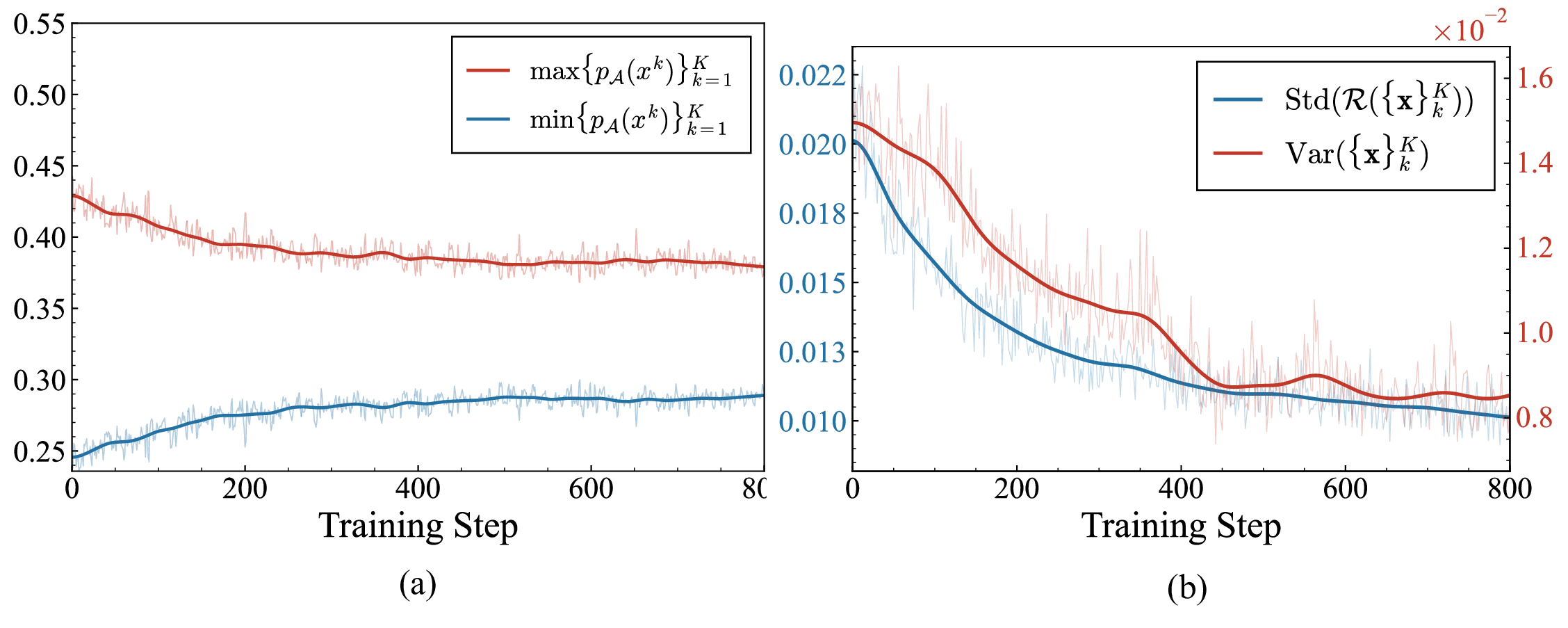
Figure 2. (a) Maximum and minimum advantage probabilities converge. (b) Reward standard deviation decreases alongside sample variance, supporting the mode-seeking convergence onto a narrow high-reward region.
Since standard entropy cannot capture diversity collapse in flow models, we introduce perceptual entropy $\mathcal{H}_{\mathrm{perc}}$, which measures diversity in the representation space of reward models rather than the VAE latent space. We further establish an empirical entropy mechanism analogous to LLMs:
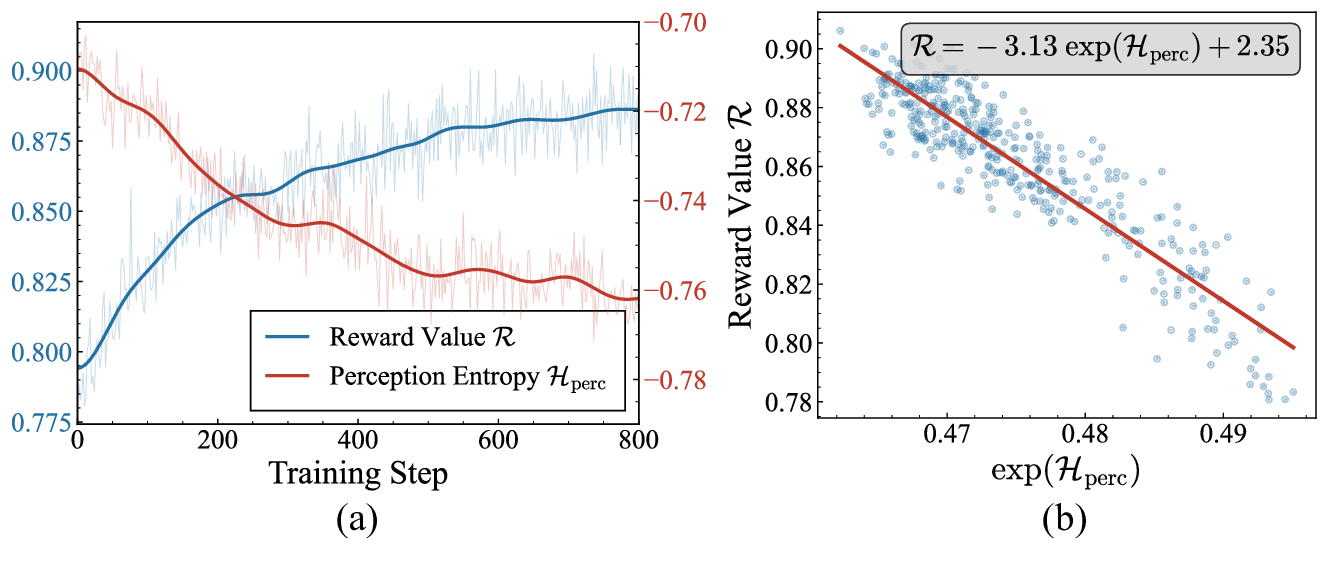
Figure 3. Relationship between Reward and Perceptual Entropy, validating the empirical entropy mechanism for flow models.
Perceptual entropy is proportional to the variance of samples in perceptual space: $\mathcal{H}_{\text{perc}} \propto \mathrm{Var}(\{\phi(\mathbf{x}_{t-1}^k)\})$. Unlike standard entropy, it faithfully tracks diversity collapse and aligns with existing entropy-based methods from LLMs.
PEC incorporates perceptual entropy directly into the reward function, treating it as a reward component that encourages the model to maintain high perceptual diversity:
PCVAE aligns the collapsed perceptual distribution with the constant VAE distribution by minimizing their KL divergence, incorporated as a unified reward:
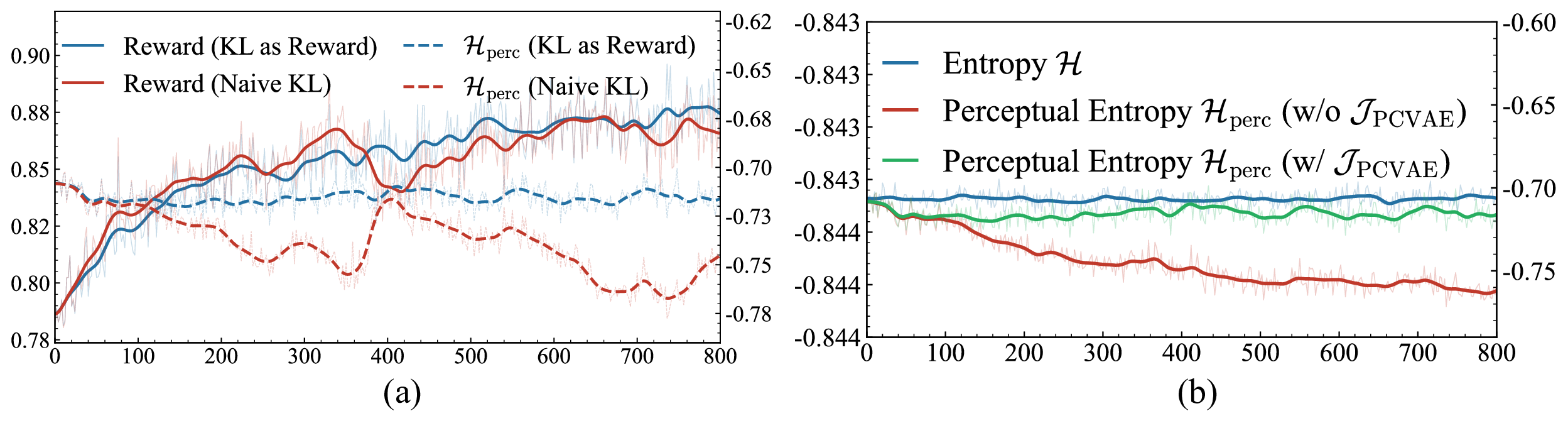
Figure 4. (a) Naïve KL (red) vs. KL as Reward (blue) — our unified reward formulation provides stable optimization. (b) Entropy with (blue) and without (red) PCVAE.
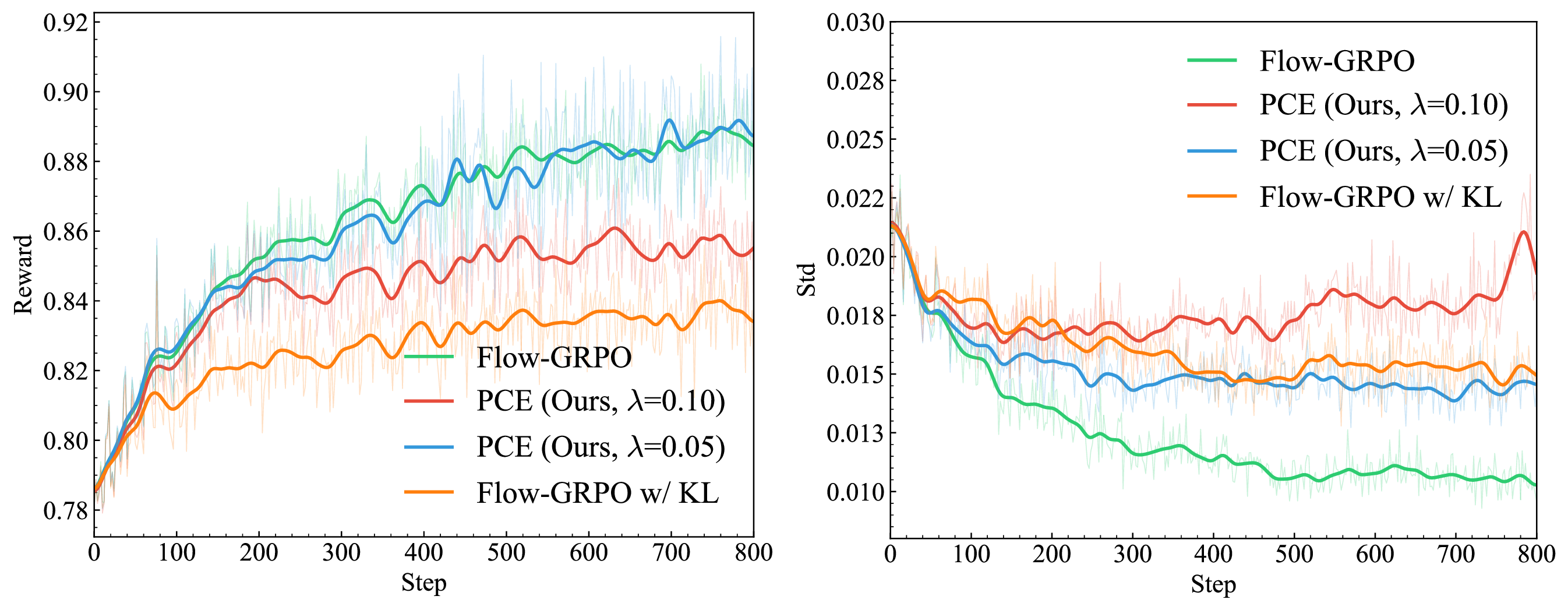
Figure 5. Training dynamics of Flow-GRPO, Flow-GRPO+KL, and PEC with perceptual entropy. (a) Mean reward. (b) Reward standard deviation. Flow-GRPO improves quality but reduces diversity; KL alleviates the drop at a quality cost; PEC strikes a better balance ($\lambda{=}0.10$ preserves diversity, $\lambda{=}0.05$ keeps quality close to Flow-GRPO).
We compare against various entropy-based regularization methods on FLUX.dev and SD3.5-M, with PickScore, DINO, and CLIP perceptual encoders. Our methods (PEC & PCVAE) using perceptual entropy consistently outperform standard entropy variants across quality and diversity metrics. PEC achieves the best overall score of 0.734, and a complementary setting of PEC further reaches a diversity average of 0.989.
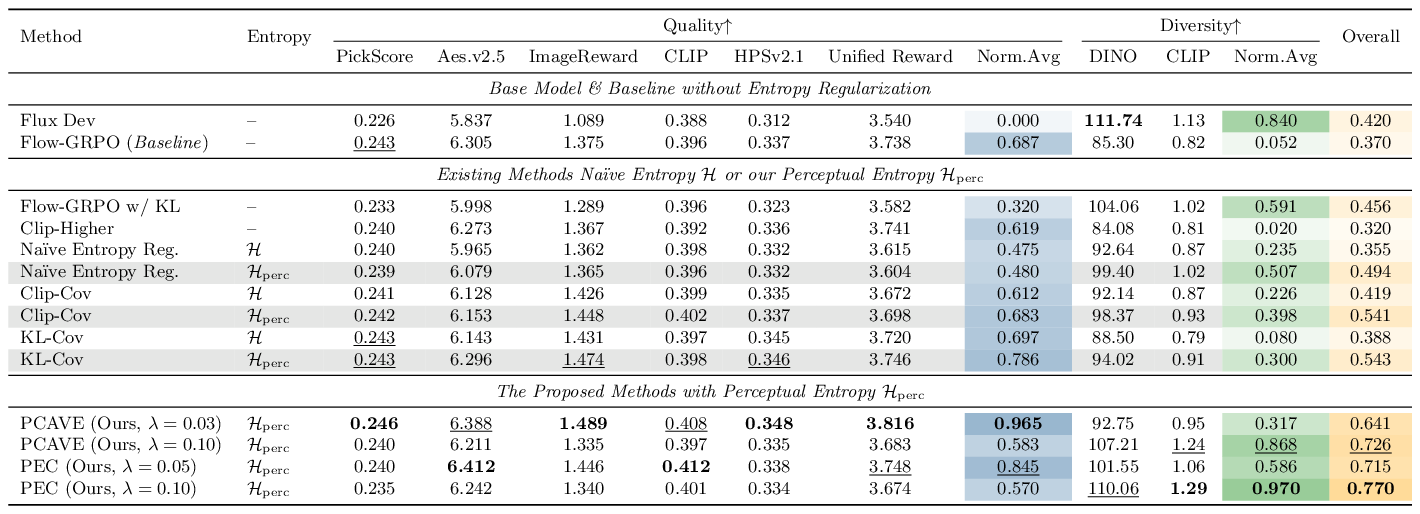
Table 1. Entropy Regularization Comparison. Gray-shaded rows denote our methods. Abbreviations: P.S.=PickScore, I.R.=ImageReward, U.R.=Unified Reward, V.S.=Vendi Score. Bold = best, underline = second best.
We compare against state-of-the-art pretrained models including SDXL, SD-3.5, HiDream-Dev, and Qwen-Image. Existing models exhibit a clear quality–diversity trade-off: SDXL attains the highest diversity (0.937) but a lower quality (0.205), while Qwen-Image attains higher quality (0.711) with substantially reduced diversity (0.045). PEC with perceptual entropy achieves the best overall score of 0.702 while maintaining strong diversity of 0.773.
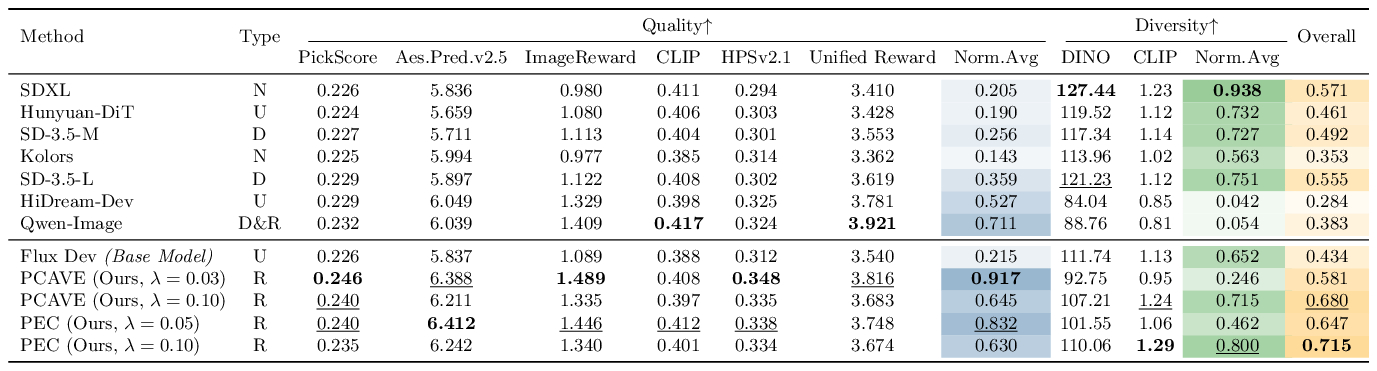
Table 2. SoTA Comparison. Type denotes post-training: N=None, U=Unknown, D=DPO, R=Reinforcement Fine-Tuning.
Replacing the native per-step entropy $\mathcal{H}$ with perceptual entropy $\mathcal{H}_{\mathrm{perc}}$ inside PEC consistently improves every metric, confirming that the gains stem from operating in perceptual space rather than from any other implementation detail.
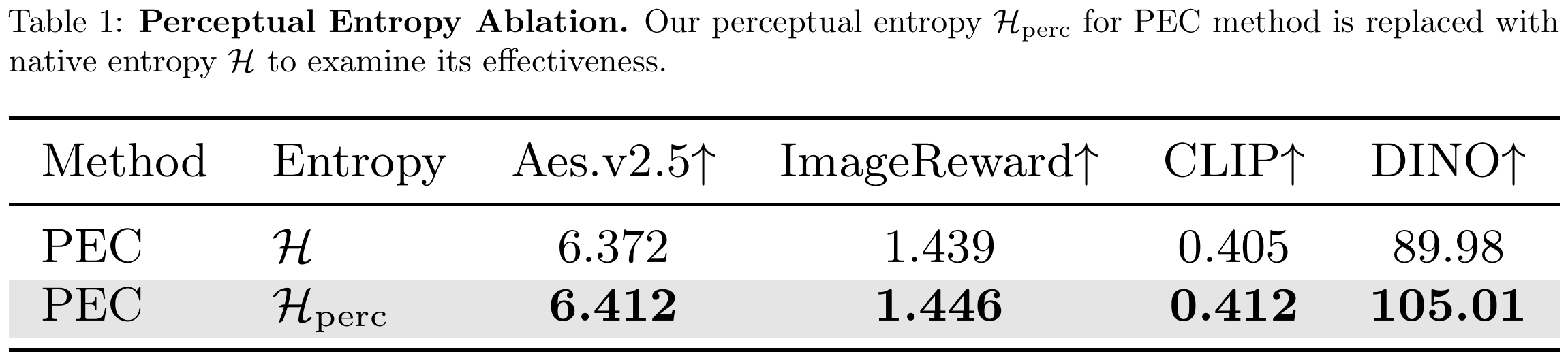
Table 3. Perceptual Entropy Ablation. Our perceptual entropy $\mathcal{H}_{\mathrm{perc}}$ for PEC is replaced with native entropy $\mathcal{H}$ to examine its effectiveness.
The perceptual encoder is much smaller than the flow model and is evaluated asynchronously from generation and optimization, so additional iteration-time overhead is marginal and peak memory usage is nearly unchanged.
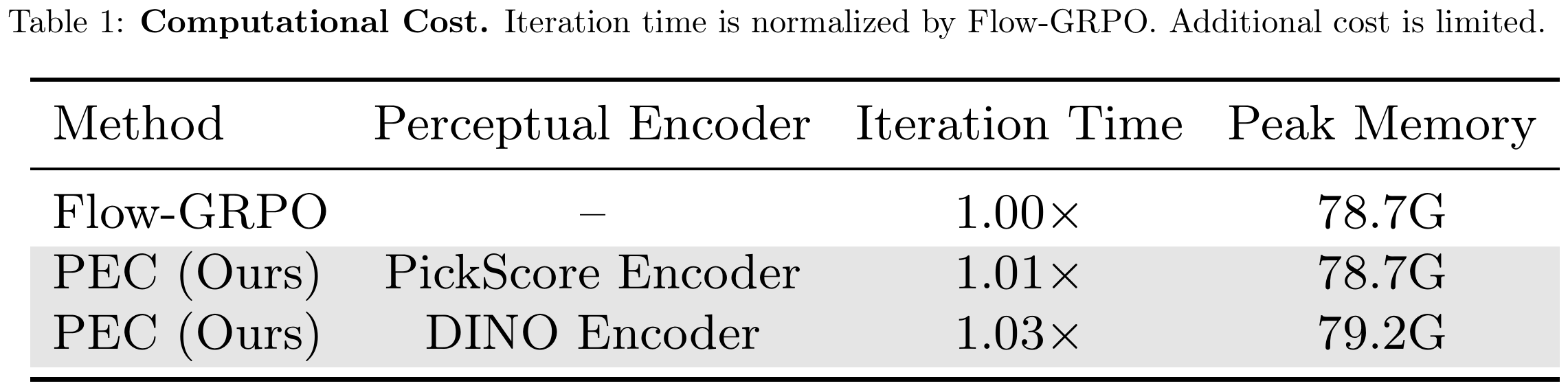
Table 4. Computational Cost. Iteration time is normalized by Flow-GRPO. Additional cost is limited.
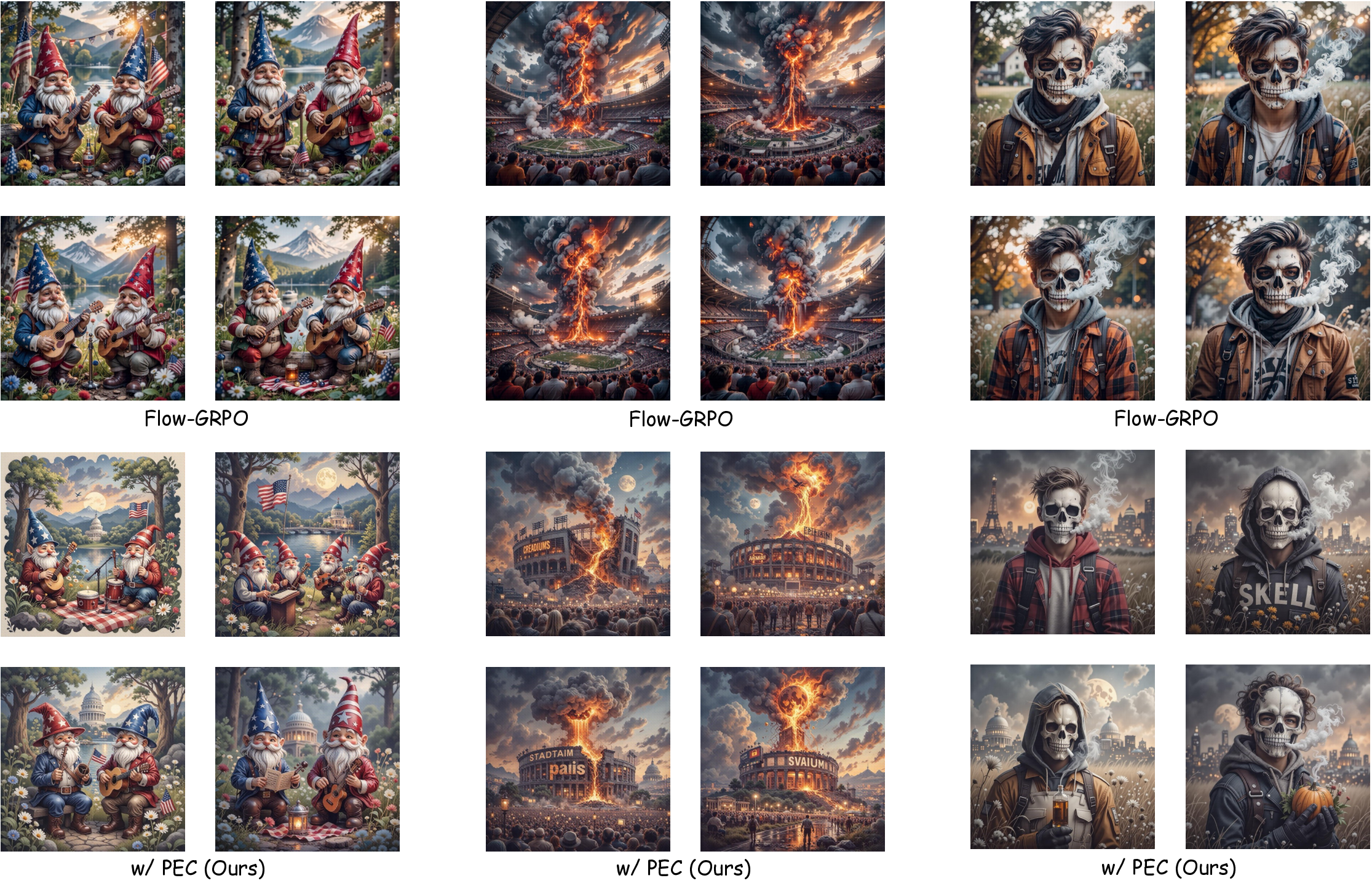
Extended diversity visualization across various prompts, showing consistent improvements in both quality and diversity.
@article{tan2026perceptualentropy,
  title={When Policy Entropy Constraint Fails: Preserving Diversity in Flow-based RLHF via Perceptual Entropy},
  author={Tan, Xiaofeng and Liu, Jun and Gao, Bin-Bin and Fan, Yuanting and Jiang, Xi and Wang, Chengjie and Wang, Hongsong and Zheng, Feng},
  journal={arXiv preprint},
  year={2026}
}